![[back]](/assets/home_24dp_E3E3E3_FILL0_wght400_GRAD0_opsz24.svg "[back]")
![[search]](/assets/search_24dp_E3E3E3_FILL0_wght400_GRAD0_opsz24.svg "[search]")
Jesus Apostles
- The Twelve (standard GNT list)
- Paul
- Philip
- John
- Gospels writers
- Significant Non-Twelve Figures
- Apostles of Jesus Lifespan
- Authors of the Greek New Testament
- Why 12 is related to the Zodiac
- Simon is Peter
- Peter has a Mother in Law
- The Apostles were Young, not Old
- Apostolic Ignorance
- Apostolic Greed and Cowardice
- The Apostles were Eunuchs
- The Apostles preferred language was Koine Greek with Atticisms
- Feminine Apostles
- Phoebe — administrative authority, patron, emissary
- Junia — apostolic status
- Priscilla — doctrinal instructor
- Mary Magdalene — primary witness, transmitter, ritual operator
- Nympha — assembly host and organizer
- Chloe — network leader
- Joanna — financial patron
- Philip’s daughters — prophetic speakers
- Tryphena and Tryphosa — labor operators
- Persis — distinguished laborer
- Euodia and Syntyche — co-combatants in mission
- Lydia of Thyatira — merchant patron, household head, assembly founder
The Twelve (standard GNT list)
There were 12 original diciples
From Matthew 10:2–4; Mark 3:16–19; Luke 6:14–16:
- Σίμων ὁ λεγόμενος Πέτρος (Simon called Peter)
- Ἀνδρέας (Andrew — Peter’s brother)
- You can see the “brother” phrasing right in Matthew 10:2 (“…Simon… and Andrew his brother; James… and John his brother”). Oxford Academic
- Ἰάκωβος (James son of Zebedee)
- Ἰωάννης (John — James’s brother)
- Φίλιππος (Philip)
- Βαρθολομαῖος (Bartholomew, often identified with Nathanael)
- Θωμᾶς (Thomas, called Didymus, "the Twin")
- Ματθαῖος (Matthew the tax collector - (Levi))
- Ἰάκωβος τοῦ Ἁλφαίου (James son of Alphaeus)
- Θαδδαῖος (Thaddaeus, also called Lebbaeus or Judas son of James)
- Σίμων ὁ Καναναῖος (Simon the Zealot)
- Ἰούδας Ἰσκαριώτης (Judas Iscariot)
- replaced by Matthias after Judas’s death, Acts 1:26
In the New Testament the symbolism of “twelve” points to the twelve tribes of Israel (e.g., “you will sit on twelve thrones judging the twelve tribes,” Matt 19:28; Luke 22:30)
The lists in Matthew, Mark, and Luke differ slightly (especially Thaddaeus/Judas son of James). Even the earliest tradition was unstable.
But we'll see shortly, that 12 is not everyone....
Paul
Paul isn’t in the canonical list of the Twelve.
Outsider status
The Twelve are the inner circle chosen by Jesus during his lifetime (names given in Matt 10, Mark 3, Luke 6). Paul comes later. In his own letters (e.g. Galatians 1:1, 1 Cor 15:8–9) he emphasizes that he was called “as one untimely born” (ὡσπερεὶ τῷ ἐκτρώματι) and that he is not one of the Twelve but an apostle by special vision/revelation.
After Judas Iscariot’s death, Acts 1:26 says the group replaced him with Matthias to restore the number to twelve. Paul is outside that system.
- Paul = later missionary, calls himself “apostle to the nations,” but never counted among “the Twelve.”
- Quote: Galatians 2 (“those who were reputed to be pillars”) sharpens the sense of rivalry between Paul and the Jerusalem circle.
Philip
8 τῇ δὲ ἐπαύριον ἐξελθόντες ἤλθομεν εἰς Καισαρίαν, καὶ εἰσελθόντες εἰς τὸν οἶκον Φιλίππου τοῦ εὐαγγελιστοῦ ὄντος ἐκ τῶν ἑπτὰ ἐμείναμεν παρ’ αὐτῷ. 9 τούτῳ δὲ ἦσαν θυγατέρες τέσσαρες παρθένοι προφητεύουσαι.
8 Leaving the next day, we went on to Caesarea and stayed at the home of Philip the evangelist, who was one of the Seven. 9 He had four unmarried daughters who prophesied.
John
John is a magus
μεθ' ἡμῶν. ὁ οὖν Ἰωάννης εἶπεν πρὸς τοὺς ταξεώτας· ἐπὶ ποίᾳ αἰτίᾳ κράτησιν ἡμῶν ποιεῖσθε; οἱ δὲ εἶπον· ἐπὶ μαγικῇ (1 κακοτεχνίᾳ. ὁ δὲ Ἰωάννης εἶπεν πρὸς αὐτούς· καὶ τίς ὁ κατή-
With us. John therefore said to the officers, On what charge are you making an arrest of us? And they said, On account of magical bad-technology. And John said to them, And who is our accuser?
Gospels writers
Canonical Gospels are attributed, then tradition names them as:
- Μᾶρκος (Mark) — companion of Peter, often identified with “John Mark” in Acts.
- Consensus View: Around 70-75 CE.
- Ματθαῖος (Matthew) — traditionally one of the disciples, “the tax-collector.”
- Consensus View: Around 75-85 CE.
- Λουκᾶς (Luke) — companion of Paul, physician, author of both the Gospel and Acts.
- Consensus View: Around 80-90 CE.
- Ἰωάννης (John) — “the beloved disciple,” son of Zebedee, though modern scholars doubt the direct authorship.
- Consensus View: Around 90-100 CE.
Dr Hillman: I'm going to resort to John Scarboro's training, and I'm just going to, look at the primary sources. To me it's all that matters. If you ask me the same question of when Mark was dated or when the New Testament, I would answer from the perspective of reading it. And say, "What other texts have I read that are using similar vocabulary and style?" And from that you can put it straight: first to second, late first, second, centuries. And it's meshing perfectly with the apocryphal. These texts are using the same vocabulary. It's gorgeous. So I would put it, look: These are second century texts.Danny: That's consensus or or what?
Luke Gorton: The consensus and again....
Danny: I hate it when people always fall back on consensus for everything cuz that's what most people in my experience have done when I ask for expletive you know.
Luke Gorton: Sure. Yeah. The consensus is it was probably written in the 60s like around 65. Which is last half of the first century of course. Um, the consensus, for whatever that's worth, is that it was written in the in the years leading up to the Jewish revolt against the Romans, which which took place between ' 66 and 70, which is a a watershed event in in Jewish and Roman relations, as you can imagine.
Danny: So, so that would have been Mark.
Luke Gorton: That would have been Mark. And then the and then again, the we're talking the consensus here is that Matthew and Luke were a little bit later. Um, again the consensus is that Matthew and Luke use Mark as a source because they have a lot of the same material. The three of them, Mark, Matthew, and Luke are called the synoptic gospels, right? Which comes from two Greek words that mean to see together, sinoptic. Um, so they seem they have a lot of the same material. The consensus is that Matthew and Luke already have Mark in front of them. So Mark had already been written by the time Matthew and Luke are writing their gospels, which can which can help explain why they have so much similar material. Luke right in his prologue says, "I wasn't there, but i've done my research and I'm using sources." So Luke tells us right up front that he is reading earlier material and talking to eyewitnesses because Luke wasn't there. He didn't see Jesus. So, so Luke tells us right up front he has earlier sources and it seems like Mark was probably one of them. Uh John is kind of off in his own world doing his own thing. Um he he's he he has a lot of different material from the other three gospels. Most people date John as the latest one, maybe in the 90s, but some people would put it later. Um, Matthew and Luke maybe being in the 70s or 80s, but again, I think I think these are all estimates.
These four Gospels form the backbone of the Greek New Testament
The New Testament has many more authors: Paul is by far the most prolific (13 epistles under his name), then other letters attributed to Peter, James, John, Jude, and finally the anonymous author of Hebrews. The Apocalypse is ascribed to John.
Significant Non-Twelve Figures
- Paul (Saul of Tarsus)
- Never among the Twelve.
- Called himself an “apostle” on the basis of his visionary initiation (Galatians 1:1, 1 Cor 9:1).
- Author of the earliest surviving letters, which shaped the theology more than almost any other single figure.
- Barnabas
- Companion of Paul on missions (Acts 13–15).
- Called an “apostle” in Acts 14:14, though not one of the Twelve.
- Important mediator between Paul and Jerusalem leaders.
- James “the Brother of the Lord” (Ἰάκωβος ὁ ἀδελφόθεος)
- Not one of the Twelve.
- Became head of the Jerusalem community after Jesus’ death.
- Tradition says he was martyred ~62 CE.
- Sometimes called an apostle in a broader sense.
- Luke
- Not one of the Twelve.
- Companion of Paul (called “the beloved physician” in Colossians 4:14).
- Author of the Gospel of Luke and Acts of the Apostles.
- Mark (John Mark)
- Not one of the Twelve.
- Traditionally linked to Peter (called his “interpreter”).
- Credited with the Gospel of Mark.
- Matthias
- Chosen by lot to replace Judas Iscariot (Acts 1:26).
- Not among the original Twelve, but became part of the circle afterwards.
- Mary Magdalene (Μαρία ἡ Μαγδαληνή)
- Not counted in the Twelve (since it is a male-coded list), but a key visionary figure.
- First to see Jesus in the resurrection accounts (John 20).
- Later Gnostic/alternative writings (Gospel of Mary) elevate her authority over the apostles.
So if we think in terms of power figures in the cult, the Twelve are just the ritualized list. The real forces shaping the movement also include Paul, James the Brother, Barnabas, Luke, Mark, and Mary Magdalene.
Apostles of Jesus Lifespan
| Apostle | Birth (est.) | Death (est./tradition) | Notes |
|---|---|---|---|
| Simon Peter | c. 1–10 CE | c. 64–67 CE (Rome, crucified upside-down under Nero) | Leader of the Twelve |
| Andrew (brother of Peter) | early 1st c. | c. 60–70 CE (Patras, crucifixion) | Mission to Greece |
| James son of Zebedee | unknown | 44 CE (executed by Herod Agrippa, Acts 12:2) | Only apostolic death in NT |
| John son of Zebedee | c. 0–10 CE? | c. 90–100 CE (Ephesus, natural death per tradition) | “Beloved disciple” |
| Philip | unknown | c. 80 CE (Hierapolis, crucifixion/stoning) | |
| Bartholomew (Nathanael?) | unknown | c. 70–100 CE (flayed/crucified, Armenia or India) | |
| Thomas (Didymus, “Twin”) | unknown | c. 72 CE (India, speared) | |
| Matthew (Levi) | unknown | c. 70–100 CE (traditions vary: Ethiopia, Persia) | Attributed author of Gospel |
| James son of Alphaeus | unknown | c. 62 CE (stoned/beheaded in Jerusalem) | Often conflated w/ James the Just |
| Thaddaeus (Judas son of James, Lebbaeus) | unknown | 60s–70s CE (traditions: Syria/Persia) | |
| Simon the Zealot | unknown | unknown (traditions: Persia/Britain) | Revolutionary zeal link |
| Judas Iscariot | unknown | c. 30 CE (suicide/fall, Matt 27 / Acts 1) | Replaced by Matthias |
| Matthias (replacement) | unknown | unknown (stoned/beheaded, traditions: Jerusalem/Colchis) | Acts 1:26 |
| Paul (Saul) | c. 5 CE (Tarsus) | c. 64–67 CE (Rome, beheaded under Nero) | “Apostle to the nations” |
| Barnabas | early 1st c. (Cyprus) | c. 61 CE (traditions: stoned in Cyprus) | Companion of Paul, called an “apostle” in Acts 14:14 |
| James the Just (Brother of the Lord) | c. early 1st c. | c. 62 CE (stoned/beaten in Jerusalem, Josephus/Hegesippus) | Head of Jerusalem church; not one of the Twelve |
| Luke (Evangelist) | early 1st c. (Antioch?) | unknown (traditions: 84 CE, Boeotia, natural death) | Physician, companion of Paul, author of Luke–Acts |
| Mark (John Mark) | early 1st c. (Jerusalem) | c. 68 CE (Alexandria, martyred by dragging) | Companion of Peter and Paul, author of Gospel of Mark |
| Mary Magdalene | early 1st c. (Magdala) | unknown (later traditions: Ephesus or France) | Key resurrection witness; not counted among the Twelve |
- Emphasis on how little is secure here: only James son of Zebedee’s death (44 CE) is directly attested in the New Testament, and James the Just’s death (62 CE) in Josephus. Everything else = legendary. This sharpens the argument about myth-making.
Authors of the Greek New Testament
Total NT size ≈ 138,000 words (Nestle 1904). Percentages approximate by word count.
| Author (traditional) | Canonical Writings | % of NT | Non-canonical / attributed works |
|---|---|---|---|
| Paul | 13 letters (Rom–Phlm, Pastoral epistles disputed) | ~28% | Acts of Paul and Thecla, 3 Corinthians |
| Luke | Gospel of Luke + Acts | ~27% | Sometimes linked to Acts of Paul and Thecla |
| John | Gospel of John, 1–3 John, Revelation (disputed) | ~20% | Apocryphon of John (Gnostic), others not canonical |
| Matthew | Gospel of Matthew | ~13% | Gospel of the Hebrews/Nazarenes (possibly linked) |
| Mark | Gospel of Mark | ~7% | Occasionally linked to Gospel of Peter (not certain) |
| Peter | 1–2 Peter (2 Peter disputed) | ~2% | Gospel of Peter, Apocalypse of Peter |
| James | Letter of James | ~1.5% | Protoevangelium of James (infancy gospel) |
| Jude | Letter of Jude | ~0.5% | None directly, but quotes 1 Enoch, Assumption of Moses |
| Anonymous | Hebrews | ~3.5% | Pseudonymous “Pauline” in some traditions |
- Apostles: birth/death mostly unknown; only James Zebedee’s death (44 CE) is attested in Acts. The rest = tradition.
- NT Authors: Luke (27%), Paul (28%), John (20%), Matthew (13%), Mark (7%), the rest small.
- Non-canonical works: mostly apocrypha written under their names in 2nd c.
- Paul + Luke together make up over half of the NT (~55%). That undermines the idea that “the Twelve” are the main voice.
All were written >30-70 years after Jesus's death.
| Century CE | Major works | Notes |
|---|---|---|
| 50s–60s | Early Paul (1 Thess, Gal, 1–2 Cor, Romans, Philippians, Philemon, Colossians) | Earliest Greek NT texts |
| 60s–70s | James, Mark | Earliest Gospel (Mark) |
| 70s–90s | Matthew, Luke, Acts, Jude, Hebrews | Mid-late composition, incorporating oral traditions |
| 90s–100 | John (Gospel), 1–3 John, Revelation | Latest canonical NT books |
Why 12 is related to the Zodiac
In a nutshell:
- Twelve tribes of Israel = solar/astral background.
- Heracles and Mithras also structure myth in 12’s.
- Jesus is re-enacting this “dodekad” scheme.
There are 12 disciples. That's not because of the 12 tribes. Jesus was establishing the Aionic order, the Dodekad. Just like Heracles did, by his 12 labors, established the worship of the 12. It's Zodiacal. Ancient Hebrews followed Zodiac worship.
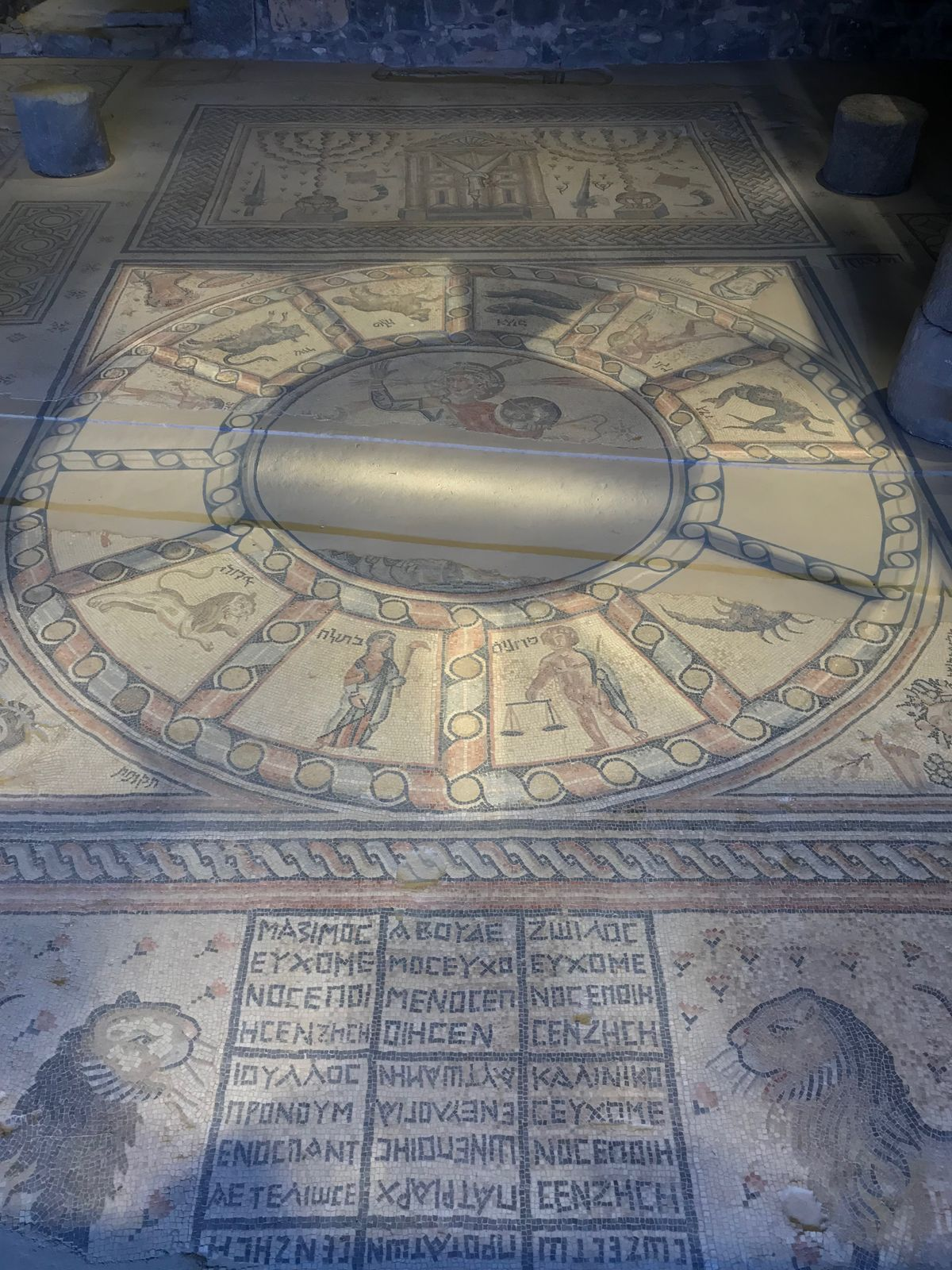
4th century synagogue with zodiac, the god Helios in the center, and ancient greek language
In the center panel sits a magnificent zodiac wheel, featuring, among other pagan images, depictions of naked humans—including a conspicuously uncircumcised Libra. The wheel encircles a haloed Helios, the Greek sun god, mounted atop his chariot. Women representing each of the four seasons sit to the corners of the zodiac, with the accompanying Hebrew inscription of the names of the seasons.
Pagan imagery in a house of worship would appear a flagrant violation of their own "Thou shalt not make unto thee any graven image," but similar synagogue zodiacs have been found in sites such as Tzippori and Beth Alpha.
This is why we say that Jesus and the ancient Hebrews were following the same tradition that was older.
Each boy represented a star-sign, just as in the Orphic and Mithraic mysteries the initiate passes through the 12 gates of heaven. The “fishermen” were not literal, but Piscine—Pisces. The “twins” echo Gemini. The traitor with the purse is Libra with its scales. When Jesus sets them in order, he is arranging the zodiacal table, a thiasos of astral tokens.
Art history around the Mediterranean?
- Late-antique synagogue mosaics in the Levant (Hammat Tiberias, Sepphoris, Beth Alpha) famously show a Greek-language zodiac wheel with Helios. SmarthistoryBryn Mawr Classical Review
- Medieval church portals and windows (e.g., Chartres) often pair the Zodiac with the Labors of the Months as a cosmic calendar; again, no apostle mapping. diglib.library.vanderbilt.eduemployees.oneonta.eduDeep Blue Repositories
Early-modern curiosity (closest you’ll get to a mapping):
- In 1627 Julius Schiller published Coelum Stellatum Christianum, a star atlas that replaced the zodiac with the Twelve Apostles (e.g., Aries = Peter, Taurus = Andrew, Gemini = James the Greater, Cancer = John, Leo = Thomas, Virgo = James the Less, Libra = Philip, Scorpio = Bartholomew, Sagittarius = Matthew, Capricorn = Simon the Zealot, Aquarius = Jude/Thaddaeus, Pisces = Matthias). It’s a pious re-labeling project from the 17th century—not an ancient tradition—but it’s the only explicit, complete mapping I can point to. Wikipedia
Simon is Peter
ἀποκριθεὶς δὲ ὁ Ἰησοῦς εἶπεν αὐτῷ·Μακάριος εἶ, Σίμων Βαριωνᾶ…κἀγὼ δέ σοι λέγω ὅτι σὺ εἶ Πέτρος
Jesus answered him:“Blessed are you, Simon son of Jonah… and I tell you that you are Peter.”
εἶπεν· Σὺ εἶ Σίμων ὁ υἱὸς Ἰωάννου· σὺ κληθήσῃ Κηφᾶςὃ ἑρμηνεύεται Πέτρος
“You are Simon son of John; you shall be called Cephas (which is translated Peter).”
Peter has a Mother in Law
29 Καὶ εὐθὺς ἐκ τῆς συναγωγῆς ἐξελθόντες ἦλθον εἰς τὴν οἰκίαν Σίμωνος καὶ Ἀνδρέου μετὰ Ἰακώβου καὶ Ἰωάννου.30 ἡ δὲ πενθερὰ Σίμωνος κατέκειτο πυρέσσουσα, καὶ εὐθὺς λέγουσιν αὐτῷ περὶ αὐτῆς.31 καὶ προσελθὼν ἤγειρεν αὐτὴν κρατήσας τῆς χειρός…
29 And immediately, coming out of the synagogue, they went into the house of Simon and Andrew, with James and John.30 Now Simon’s mother-in-law was lying sick with a fever, and they immediately told him about her.31 And coming to her, he raised her up, taking her by the hand…
εἶδεν τὴν πενθερὰν αὐτοῦ βεβλημένην καὶ πυρέσσουσαν“
He saw his mother-in-law lying down and feverish…”
ἡ πενθερὰ τοῦ Σίμωνος ἦν συνεχομένη πυρετῷ μεγάλῳ“
Simon’s mother-in-law was held by a great fever…”
Sounds like Peter/Simon is married. (this doesn't prove taxable age).
The Apostles were Young, not Old
Let's pretend that they're bearded men around 30CE when Jesus died (25-50yrs old), then how did they live to ~70-110 CE to write the New Testament?
- If the apostles were already mature men in 30 CE, the later literary attributions strain biological plausibility and require layered redaction assumptions
The Gospels themselves call them neaniskoi νεανίσκοι, a term for sexual maturity neaniskos refers to young and small (mikros/μικρός says Heyschius, which means small) boys barely pubescent. The Gospel narrative repeatedly frames apostles around Jesus using youth-status language (νεανίσκος / παιδάριον), dependency markers, and guardian-style speech patterns, rather than settled adult householders. None have wives, nor homes.
- Mark 14:51 (the fleeing νεανίσκος)
- Mark 16:5 (νεανίσκος at the tomb)
- Elsewhere as a social-age descriptor language (dependency markers, and guardian-style speech patterns, no wives, homes)
- Peter, who is older, may have had a wife (his mother-in-law appears in Mark 1:29–31)
- The others are never depicted functioning as household heads, property owners, or legally independent family units.
- see neaniskos - For philological analysis of neaniskos's biological maturity.
Only one of them (Jesus) qualified (of age) to pay to the tax-collectors (attested in the NT), none were gray-bearded sages. Read on for the source text evidence:
Jesus is taxable age, Peter may be, Other apostles do not qualify
In the didrachma episode (Matt 17:24–27), payment is ultimately rendered for Jesus, which presupposes that Jesus himself is within the class that could be expected to pay.
Jesus's argument asserts status-based exemption (υἱοί vs. ἀλλότριοι) for the other apostles as "sons" below the taxable age...
NOTE: In the Greek New Testament, Σίμων (Simon) and Πέτρος (Peter) are two names for the same individual.
24 Ἐλθόντων δὲ αὐτῶν εἰς Καφαρναοὺμ, προσῆλθον οἱ τὰ δίδραχμα λαμβάνοντες τῷ Πέτρῳ καὶ εἶπαν·Ὁ διδάσκαλος ὑμῶν οὐ τελεῖ τὰ δίδραχμα;
24 When they came into Capernaum, the (tax) collectors of the didrachma (money) came to Peter and said: “Does your teacher not pay the didrachma?”
25 λέγει· Ναί. καὶ ἐλθόντα εἰς τὴν οἰκίαν προέφθασεν αὐτὸν ὁ Ἰησοῦς λέγων·Τί σοι δοκεῖ, Σίμων; οἱ βασιλεῖς τῆς γῆς ἀπὸ τίνων λαμβάνουσι τέλη ἢ κῆνσον; ἀπὸ τῶν υἱῶν αὐτῶν ἢ ἀπὸ τῶν ἀλλοτρίων;
25 He said, Yes. And when he entered the house, Jesus spoke first, saying: “What do you think, Simon (Peter)? From whom do the kings of the earth take taxes or tribute — from their own sons, or from strangers?”
26 εἰπόντος δὲ· Ἀπὸ τῶν ἀλλοτρίων, ἔφη αὐτῷ ὁ Ἰησοῦς·Ἄραγε ἐλεύθεροί εἰσιν οἱ υἱοί.
26 When he (Simon/Peter) said, From strangers, Jesus said to him: “Therefore the sons are free.”
27 ἵνα δὲ μὴ σκανδαλίσωμεν αὐτούς,
πορευθεὶς εἰς θάλασσαν βάλε ἄγκιστρον,
καὶ τὸν ἀναβάντα πρῶτον ἰχθὺν ἆρον·
καὶ ἀνοίξας τὸ στόμα αὐτοῦ εὑρήσεις στατῆρα·
ἐκεῖνον λαβὼν δὸς αὐτοῖς ἀντὶ ἐμοῦ καὶ σοῦ.
27 But so that we may not offend them,go to the sea, cast a hook,
and take the first fish that comes up;
and when you open its mouth you will find a stater;
take that and give it to them in place of me and you.
- δίδραχμα corresponds to the half-shekel Temple tax, payable by adult males.
- sons here appears to be a term of endearment (our male youths), or a ritual term (son of god), for the other younger apostles
Notice:
- The collectors approach outside, in public
- the tax collectors approach only Peter, seeking his teacher
- the tax collectors are only seeking Jesus
- the tax collectors name no one else
- The tax collectors do not ask Peter for his taxes, only for his teacher's taxes, as if he's the oldest responsible boy, but not of age for taxes
- as if Peter's the oldest one in charge to go get adult help here
- if multiple adult males were liable, they would be addressed
- Peter enters the house to get Jesus who is of age to pay
- Jesus speaks first, framing the legal reasoning
- Jesus’ argument hinges on υἱοί vs. ἀλλότριοι - sons vs. non-sons.
- The exemption logic only works if those present are not assumed to be taxable adults.
- Payment is arranged without Peter exercising independent authority
- Ultimately Jesus pays for "me and you"
- assuming this is Peter, may place Peter of taxable age.
This is exactly how a senior household member interacts with a dependent younger male in Greek narrative.
Nowhere in the Gospels:
- Are James, John, Andrew, Philip, etc. asked for tax
- Are they depicted independently handling money
- Are they shown as householders or heads of taxable units
Instead, they are repeatedly:
- Called neaniskos νεανίσκοι / παιδίσκοι (small male youths, just pubescent in maturity)
- Sleeping together
- Traveling under guardianship
- Spoken for by others
Bottom Line:
- Jesus is of taxable age
- Peter may be of taxable age
- the other apostles are consistently portrayed as non-liable dependents, most plausibly younger than taxable age
- the other apostles here, seem to be exempt from taxes, therefore younger than taxable age.
Taxable age is 20 years old
In 30 CE, the age at which a male became liable for the Temple half-shekel (δίδραχμα) was twenty years old — and this is attested directly in the Greek Septuagint, not later rabbinic tradition.
πᾶς ὁ διαπορευόμενος εἰς ἀριθμόν, ἀπὸ εἴκοσι ἐτῶν καὶ ἐπάνω, δώσει τὴν εἰσφορὰν Κυρίῳ.
“Everyone who passes into the census, from twenty years and upward, shall give the contribution to the Lord.”
Age of Paul
There is no Gospel tax scene involving Paul, because:
- Paul is not part of the Jesus movement during the Gospel period
- He appears later, in Acts and his letters
- Explicitly discusses tax obligation as binding (Romans 13)
- Moves freely as a legally autonomous male
- Is treated by authorities as a responsible adult citizen
Bottom Line:
- Likely that Paul is of taxable age.
- Unlike the Gospel disciples, Paul is never framed as a dependent youth or spoken for by others.
Why youths? What's the benefit?
See The Apostles were Eunuchs writeup below... for more.
12 εἰσὶν γὰρ εὐνοῦχοι οἵτινες ἐκ κοιλίας μητρὸς ἐγεννήθησαν οὕτως, καὶ εἰσὶν εὐνοῦχοι οἵτινες εὐνουχίσθησαν ὑπὸ τῶν ἀνθρώπων καὶ εἰσὶν εὐνοῦχοι οἵτινες εὐνούχισαν ἑαυτοὺς διὰ τὴν βασιλείαν τῶν οὐρανῶν. ὁ δυνάμενος χωρεῖν χωρείτω.
12 “For there are eunuchs who were born so from their mother’s womb,
and there are eunuchs who were made eunuchs by men
and there are eunuchs who made themselves eunuchs because of the kingdom of the heavens.
Let the one who is able to receive this, receive it.”
- Eunuchs were created, and then utilized, to experience the kingdom of heaven.
They were chosen because their bodies, like those of venom pharmakos victims, were considered ritually potent. Their blood and serum, under venom exposure, produced antivenom. This is what they brought to the rite, not wisdom.
they helped Jesus see the kingdom of heaven.
- See Mark 14-51 Translation from Source for the n4k3d youth (gumnos neaniskos) running away as Jesus is arrested in a public park at 4am.
- See Dragon Master - Neal and Neaniskos - an article that digs deep into the meaning of neaniskos, a maturity, not an age, refers to pubescent (freshly fertile) male youths, but typically maps to between 10-20yrs old.
Apostolic Ignorance
Despite referencing exclusively the more technical Greek Septuagint, which contains a very Hellenic and Orphic version of the inner cosmos...
...the apostle's own testaments & writings betray ignorance. They constantly fail to understand the logos. They fall asleep in Gethsemane, they scatter in fear, they deny their master. This is not wisdom; it is the normal result of drugged boys at the threshold of ecstasy. Their “visions” are pharmaka-induced:
- tetramorph cherubim,
- fiery chariots,
- tongues of fire,
- kingdom of heaven
- ἡ βασιλεία (basileía) - domain/kosmos - functional mode of ordering, not geographic
- τῶν οὐρανῶν (ouranon/sky/plerouma) - the upper ordering principle of the kosmos, not altitude
- In Greek cosmology — especially in Orphic and pre-Platonic thought — the κόσμος is structured through a vertical polarity: Γαῖα (earth, material grounding, generation) and Οὐρανός (upper order, pattern, mind, visibility, law). Οὐρανός functions as a mental and noetic register, the place where form, measure, and ordering intelligence reside.
What they saw was real only in the same sense that the Eleusinian saw Persephone in a flash of light.
- Ignorance: “They understood none of these things” (Luke 18:34).
- Greed: “Who is the greatest?” (Mark 9:34).
- Cowardice: “They all left him and fled” (Mark 14:50).
Apostolic Greed and Cowardice
Far from paragons, they are repeatedly shown as squabbling over who is greatest, betraying for silver, or fleeing naked into the night leaving only a sindon (medical grade fine linen bandage) behind. With further context for the sindon, evidence of venom poisoning given by Mark 14-51 Translation from Source:
- Oxos/Vinegar antidote given
- Extreme thirst is a symptom of venom poisoning
- Early coma discovered while breaking legs of the other lestes on crosses
From a Hellenic lens this is not a tale of divine heroes, but of misused ritual youths, bound into a rite that parodied our older mysteries. Their greed, their fear, and their ignorance expose the poverty of the sect.
The Apostles were Eunuchs
Evidence in the Early Christian Cult:
12 εἰσὶν γὰρ εὐνοῦχοι οἵτινες ἐκ κοιλίας μητρὸς ἐγεννήθησαν οὕτως, καὶ εἰσὶν εὐνοῦχοι οἵτινες εὐνουχίσθησαν ὑπὸ τῶν ἀνθρώπων καὶ εἰσὶν εὐνοῦχοι οἵτινες εὐνούχισαν ἑαυτοὺς διὰ τὴν βασιλείαν τῶν οὐρανῶν. ὁ δυνάμενος χωρεῖν χωρείτω.
12 “For there are eunuchs who were born so from their mother’s womb,
and there are eunuchs who were made eunuchs by men
and there are eunuchs who made themselves eunuchs because of the kingdom of the heavens.
Let the one who is able to receive this, receive it.”
- let the one who can receive this, receive it - is an explicit esoteric marker:
- this saying is not for everyone
- only for those with ears to hear
Eunuchs were created for the "kingdom of heaven", Jesus's kingdom, by men or by themselves.
There's a chemical castration technology used in antiquity via Hemlock held to the testicles using a Sindon bandage. A practice that goes back to pre-christian traditions, like Eleusis.
- see Eunuchs for more information on this practice
The Apostles preferred language was Koine Greek with Atticisms
Apostles used Greek, they did not rely on another language for doctrine, scripture, or theology, just Greek.
- New Testament primary source was written in Koine Greek with Atticisms, and references the Greek Septuagint
- Septuagint (Old Testament) was written in Koine Greek with Atticisms
- Koine Greek (with Atticisms) was just a slight simplification of grammar from the Attic Greek, if you know Attic, you know Koine
- the Greek of the New Testament clearly shows Atticizing tendencies (especially in vocabulary, particles, and syntax). If someone knows classical Attic, Koine is indeed mostly a simplification: fewer optatives, streamlined participial constructions, reduced case nuance.
- Not all NT authors write at the same register (Luke–Acts vs Mark, for example).
- The Greek Septuagint was quoted by the Apostles when they wrote the Greek New Testament, not the Hebrew.
- Therefore We know that Christianity was founded on the Ancient Greek Language.
- The overwhelming majority of explicit OT quotations in the Greek New Testament align with the Septuagint, often against later Hebrew traditions. This is a strong and well-established scholarly point.
- Its key theological terms (λόγος, σωτηρία, ζωή αἰώνιος, πνεῦμα, μυστήριον, χριστός) are Greek concepts, not translations.
- Its earliest communities operate in Greek-speaking urban centers.
- Greek was the authoritative language from 290BCE to 405CE, then Jerome created the Latin Vulgate for Catholicism (Orthodox ignored it, still uses Greek as authority).
- In 382CE Latin Vulgate is produced from the Greek Septuagint.
- In 405CE Latin Vulgate is produced from local town Hebrew versions with Greek filling in missing detail (% Hebrew vs Greek contribution, is unknown).
- Koine Greek dominates: Administration, Trade, Education, Philosophy, Religion
- Orthodox never switched to Latin, kept the greek, to today.
- Catholic (western world) switched to secondary sources and never looked back to the primary, (it seems that they have never really "read the bible", only derivatives).
Logical Conclusion, the apostles didn't have another language to refer to, or it wasn't relevant... so they used Greek because it was natural and already authoritative.
- see Greek is the Original Language of Christianity for more.
Feminine Apostles
In the earliest strata of the Greek sources, women are not peripheral—they appear embedded in every functional layer of the movement: funding, hosting, teaching, prophesying, transmitting, and even being counted among the apostles themselves. The evidence is not interpretive—it is lexical and textual. The Greek verbs and titles used of these women are the same ones used of recognized male operators in the assemblies. What follows is a direct chain of names → Greek text → function.
The Greek record shows women:
- acting as diakonoi (διάκονοι) and prostatides (προστάτιδες) - (administrators, patrons)
- counted among apostoloi (ἀπόστολοι)
- teaching ektithemi (ἐκτίθημι)
- prophesying propheteuou (προφητεύω)
- laboring and contending - kopiaou (κοπιάω), sunathleou (συναθλεω)
- funding, hosting, and transmitting the assemblies
Phoebe — administrative authority, patron, emissary
Φοίβην τὴν ἀδελφὴν ἡμῶν, οὖσαν καὶ διάκονον τῆς ἐκκλησίας τῆς ἐν Κεγχρεαῖς… αὐτὴ γὰρ καὶ προστάτις πολλῶν ἐγενήθη καὶ ἐμοῦ αὐτοῦ.
Phoebe our sister, being also a diakonos of the assembly in Cenchreae… for she has been a patron/protector of many, including myself.
The terms are explicit. διάκονος is an official role, not a helper; προστάτις is a patron with authority and resources. She is also the likely courier of the letter itself, making her the carrier and interpreter of Paul’s message. This is administrative and communicative authority at the highest level.
Junia — apostolic status
Ἀνδρόνικον καὶ Ἰουνίαν… οἵτινές εἰσιν ἐπίσημοι ἐν τοῖς ἀποστόλοις
Andronicus and Junia… who are notable among the apostles.
The phrase places Junia within the apostolic circle itself, and marks her as distinguished. The Greek form is feminine. This is not support work—this is apostolic rank embedded in the text.
Priscilla — doctrinal instructor
Πρίσκιλλα καὶ Ἀκύλας… προσελάβοντο αὐτὸν καὶ ἀκριβέστερον αὐτῷ ἐξέθεντο τὴν ὁδὸν τοῦ θεοῦ.
Priscilla and Aquila took him aside and explained (set forth) more accurately the way of God to him.
The verb ἐκτίθημι is instructional exposition. Priscilla participates directly in correcting and teaching Apollos, an already educated male figure. She is functioning as a teacher of doctrine, not a silent participant.
Mary Magdalene — primary witness, transmitter, ritual operator
πορεύου πρὸς τοὺς ἀδελφούς μου καὶ εἰπὲ αὐτοῖς… ἔρχεται Μαρία ἡ Μαγδαληνὴ ἀγγέλλουσα τοῖς μαθηταῖς…
Go to my brothers and tell them… Mary Magdalene comes announcing to the disciples…
She is the first transmitter of the core proclamation.
ἡ ἔνδοξος Μαρία ἡ Μαγδαληνή… ἰσαπόστολος, μυροφόρος, θαυματουργός
The glorious Mary Magdalene… equal to the apostles, bearer of myrrh, worker of wonders
The Greek titles are direct:
- ἰσαπόστολος → equal to an apostle
- μυροφόρος → bearer of ritual substances (myrrh)
- θαυματουργός → wonder-worker
She is also called μαθητρία (female disciple) and described with ἑπτὰ δαιμόνια—internal opposing forces to be harmonized. The text presents her as an initiate, operator, and transmitter, not subordinate.
Nympha — assembly host and organizer
καὶ Νύμφαν καὶ τὴν κατ’ οἶκον αὐτῆς ἐκκλησίαν
And Nympha and the assembly in her house
Control of the house = control of the gathering. She is the node through which the assembly exists.
Chloe — network leader
ἐδηλώθη μοι περὶ ὑμῶν… ὑπὸ τῶν Χλόης
>It has been made clear to me concerning you… by those of Chloe
A whole group is identified by her name. This indicates a recognized faction or household network under her authority.
Joanna — financial patron
Μαρία… καὶ Ἰωάννα… καὶ ἕτεραι πολλαί, αἵτινες διηκόνουν αὐτοῖς ἐκ τῶν ὑπαρχόντων αὐταῖς
Mary… and Joanna… and many others, who served/supported them from their own resources
This is resource control and funding—the economic backbone of the movement.
Philip’s daughters — prophetic speakers
ἦσαν δὲ τούτῳ θυγατέρες τέσσαρες παρθένοι προφητεύουσαι
He had four daughters, virgins, prophesying
προφητεύω is public speech within the assembly, not silence. These women function as voice channels of the rite.
Tryphena and Tryphosa — labor operators
Τρύφαιναν καὶ Τρυφῶσαν… τὰς κοπιώσας ἐν κυρίῳ
Tryphena and Tryphosa… women laboring in the Lord
κοπιάω = to labor to exhaustion. This verb is used for recognized workers in the mission, not passive followers.
Persis — distinguished laborer
Περσίδα… ἥτις πολλὰ ἐκοπίασεν
Persis… who labored much
She is marked as exceptional in her contribution.
Euodia and Syntyche — co-combatants in mission
αἵτινες συνήθλησάν μοι ἐν τῷ εὐαγγελίῳ
who struggled/contended alongside me in the gospel
The verb συν-athleō is agonistic combat language—they are co-strugglers in the same field as Paul.
Lydia of Thyatira — merchant patron, household head, assembly founder
καί τις γυνὴ ὀνόματι Λυδία, πορφυρόπωλις πόλεως Θυατείρων, σεβομένη τὸν θεόν, ἤκουεν… ἧς ὁ κύριος διήνοιξεν τὴν καρδίαν…
ὡς δὲ ἐβαπτίσθη καὶ ὁ οἶκος αὐτῆς, παρεκάλεσεν λέγουσα· εἰ κεκρίκατέ με πιστὴν τῷ κυρίῳ εἶναι, εἰσελθόντες εἰς τὸν οἶκόν μου μένετε.
And a certain woman named Lydia, a seller of purple from the city of Thyatira, one who reveres God, was listening… whose heart the Lord opened…
And when she was initiated (washed) along with her household, she urged them saying: If you judge me faithful to the Lord, come into my house and remain.
ἐξελθόντες δὲ ἀπὸ τῆς φυλακῆς εἰσῆλθον πρὸς τὴν Λυδίαν…
And after leaving the prison, they went to Lydia’s place…
Lydia is defined first by her trade: πορφυρόπωλις (dealer in purple)—a high-value commodity tied to elite networks, temple economies, and pharmacological dye compounds (πορφύρα). This marks her as independently wealthy and commercially embedded in long-distance trade systems. The text then places her as head of a household (ὁ οἶκος αὐτῆς)—not under a named male authority—and that entire household follows her lead. Crucially, she becomes the host location for Paul’s group, and after the prison episode, they return not to a synagogue or public hall, but to her house. This establishes Lydia as the foundational node of the assembly in Philippi: she controls resources, space, and continuity. The authority chain is explicit in the Greek: wealth (πορφυρόπωλις) → household leadership (οἶκος) → hosting the group → becoming the stable meeting point. She is not assisting the movement—she is structuring it.